A humidity percentage moves when temperature moves
A cool morning can show 90% relative humidity and still contain less water vapor than a warm afternoon at 50%. The percentage is not wrong. It describes how close the air is to saturation at that temperature.
This is useful for fog, condensation and many weather calculations. It is less direct when the question is, “Which part of the day contains more moisture?” Our guide to dew point and relative humidity explains why the percentage can produce surprising comparisons.
Absolute humidity measures water vapor by volume
NOAA describes absolute humidity as the actual amount of water vapor in the air. Its atmospheric moisture calculator reports the measurement in grams per cubic meter and uses air temperature with dew point or relative humidity to calculate it.
That makes a reading concrete. A value of 10 g/m³ means one cubic meter of air contains about 10 grams of water vapor.
It is still not a perfect constant. Air expands and contracts as temperature and pressure change, so a mass-per-volume measurement can change too. Specific humidity and mixing ratio are more useful for some scientific work. For an everyday hourly view, absolute humidity gives FeelsLike a readable measure of the moisture present in the air.
Why FeelsLike shows it
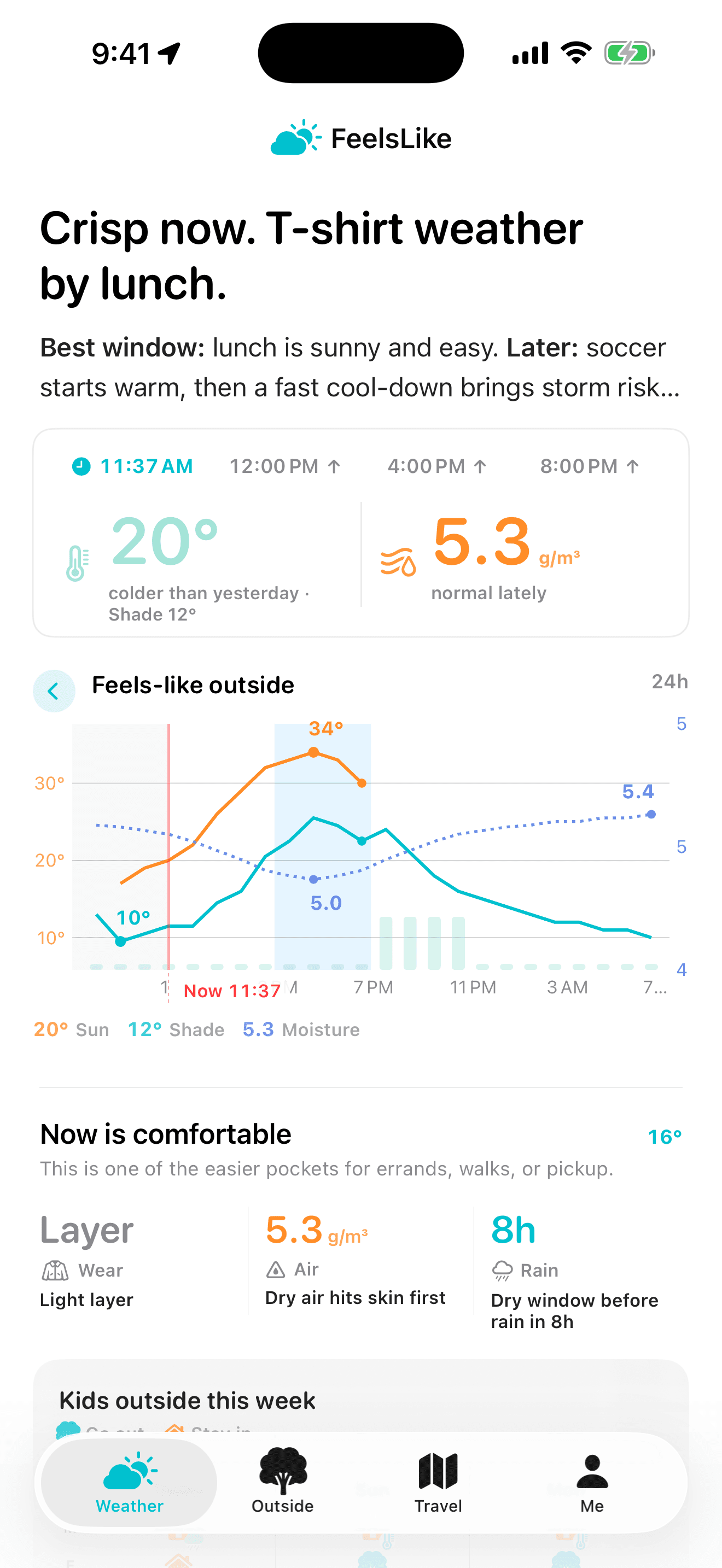
Relative humidity is useful, but it can be difficult to compare across different temperatures. FeelsLike places absolute humidity beside feels-like temperature, wind and rain through the next 24 hours. The web tool can also compare home with a destination.
The point is not to replace the forecast. It is to make the hours easier to compare. If the air becomes much wetter while the temperature stays warm, an evening walk may feel different from the same walk earlier in the day.
Read what feels-like temperature actually means before treating any single number as a verdict.
Personal weather starts with a simple check-in
Two people can stand in the same forecast and make different choices. One may be comfortable. The other may find the air sticky, dry or tiring.
The FeelsLike iPhone app lets you mark current outdoor conditions as comfortable or uncomfortable. Each record keeps the feels-like temperature, absolute humidity, wind and recent weather baseline with that answer. After five outdoor records, the app can compare new conditions with the closest records and offer a personal comfort prediction.
That is what we mean by personal weather. The forecast remains the forecast. FeelsLike adds a memory of how similar conditions felt to you.
What absolute humidity cannot tell you
Absolute humidity is not a medical measurement, a heat warning or a guarantee of comfort. Direct sun, activity, clothing, wind, access to water, health and acclimatization can change how conditions affect someone.
Follow official alerts for heat, cold, storms and air quality. Use FeelsLike for planning context, not emergency decisions.
Sources
- NOAA Air Resources Laboratory: Moisture Calculator
- NOAA NESDIS: What Is Humidity?
- National Weather Service: Dew Point vs. Humidity
Weather definitions and alert practices can vary by provider and country. Check your local weather authority for warnings and safety decisions.