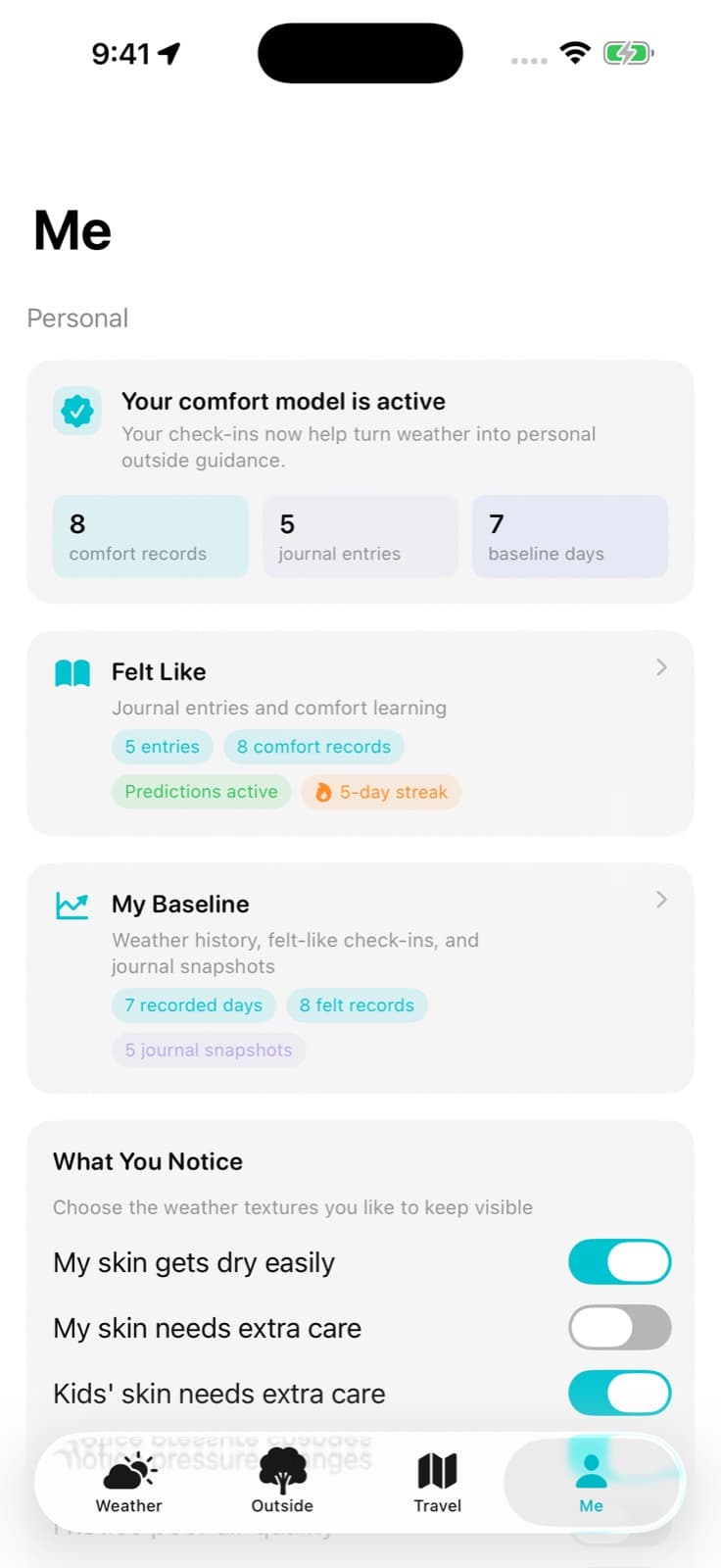
Personal weather is not a separate forecast
The forecast still comes from weather providers. FeelsLike adds a record of how similar outdoor conditions felt to you. That distinction matters: the app can add context to a forecast, but it cannot make weather data more certain or promise that you will feel the same way next time.
Public feels-like measures already combine some weather factors. The National Weather Service heat index uses temperature and relative humidity in hot conditions, while wind chill describes the cooling effect of wind and cold. Personal context asks a different question: what happened when you were outside in conditions like these?
Start with five outdoor check-ins
When you are outside, mark the conditions as comfortable or uncomfortable. FeelsLike saves the weather context with that answer. Indoor ratings are kept separate and do not affect outdoor predictions.
Predictions begin after five outdoor records. Five is a starting point, not proof that the app knows every preference. A wider range of real check-ins gives it more useful examples to compare.
What FeelsLike compares
Each outdoor record includes the feels-like temperature, absolute humidity and wind speed. It also stores how temperature and moisture compare with the recent baseline. FeelsLike then gives more weight to recent records that are closer to the current conditions.
Absolute humidity is the amount of water vapor in a volume of air, usually shown in grams per cubic meter. The NOAA atmospheric moisture calculator reports the same type of measurement. Our absolute humidity guide explains why FeelsLike uses it when comparing hours with different temperatures.
The result is deliberately simple: likely comfortable or likely uncomfortable. It is based on the closest past records, not a diagnosis or a universal comfort scale.
The recent baseline gives the number context
A mild day can feel different after a week of heat than it does after a cold spell. FeelsLike keeps a recent baseline from weather history and your recorded outdoor experience, then compares current temperature and moisture with that baseline.
This does not mean the body adapts by a fixed amount. The baseline is a comparison tool inside the app. It helps separate a familiar day from one that is unusually warm, cold, wet or dry relative to recent conditions.
What a personal prediction cannot know
The model does not know everything about your plan. Direct sun, activity, clothing, sleep, health, shade and time outside can change the experience. A comfort prediction is not medical advice, a heat-risk score, an air-quality reading or an emergency warning.
Follow official alerts for heat, cold, storms and air quality. Use the personal result for an everyday decision, then correct it with another outdoor check-in when the prediction does not match how the conditions felt.
Sources
- National Weather Service: Heat Forecast Tools
- National Weather Service: Understanding Wind Chill
- NOAA Air Resources Laboratory: Moisture Calculator
Weather definitions and alert practices can vary by provider and country. Check your local weather authority for warnings and safety decisions.