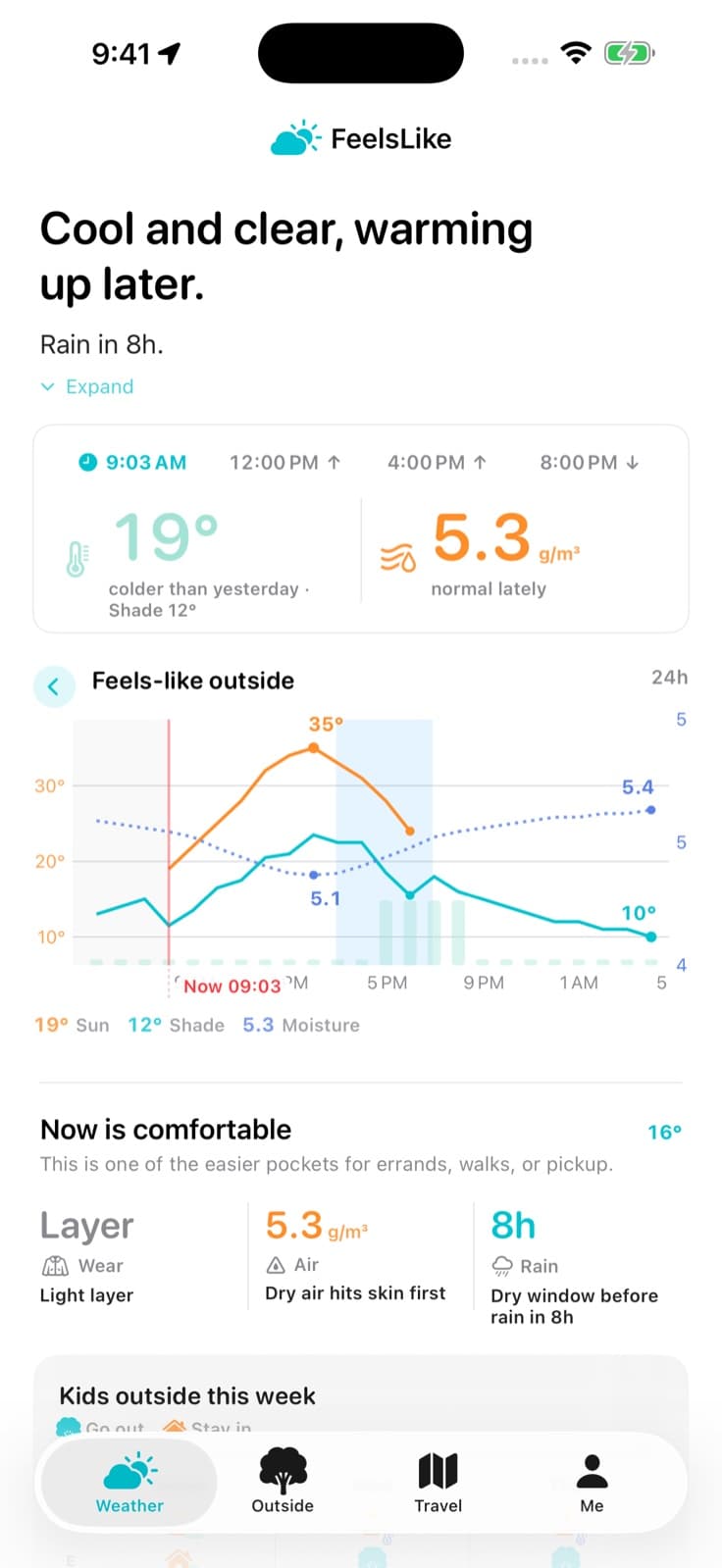
A percentage needs temperature beside it
Relative humidity tells you how close the air is to saturation at its current temperature. Because warmer air can hold more water vapor, the percentage can rise or fall even when the amount of moisture has not changed much.
That is why 90% humidity is not automatically more uncomfortable than 50%. A cool morning can reach a high percentage with little moisture in the air. A warm afternoon can show a lower percentage and still feel sticky.
Dew point tracks the moisture more directly
Dew point is the temperature to which air would need to cool to become saturated. A higher dew point means the air contains more water vapor.
The National Weather Service gives a useful comparison: air at 30°F with a 30°F dew point has 100% relative humidity, while air at 80°F with a 60°F dew point has 50% relative humidity. The warmer example contains more moisture and feels more humid even though its percentage is lower.
Where absolute humidity fits
Absolute humidity measures the mass of water vapor in a volume of air, usually in grams per cubic meter. Dew point expresses moisture as a saturation temperature. Both can make a relative-humidity percentage easier to interpret, but they are not interchangeable. Absolute humidity can change as air expands or contracts, while dew point is a different physical measurement.
The NOAA READY Moisture Calculator uses air temperature with either dew point or relative humidity to calculate absolute humidity. You can also try the FeelsLike absolute humidity calculator. FeelsLike calculates the same type of reading from third-party forecast conditions and places it beside apparent temperature across the next 24 hours.
Moist air can slow the body’s cooling
Sweat cools you when it evaporates. When the air is humid, evaporation can slow down, so hot weather may feel warmer. That relationship is one reason heat index combines air temperature with relative humidity.
Dew point alone is not a comfort score. Wind, shade, direct sun, activity, clothing and personal sensitivity can all change the experience. Official heat alerts should take priority over a comfort label in any app.
Which number should you check?
Use dew point when you want a steadier description of how much moisture is in the air. Use relative humidity when it is part of a specific calculation or when you are comparing it with the current temperature. For an outdoor plan, read both as context rather than treating either one as the answer.
FeelsLike keeps humidity beside apparent temperature and rain across the hours ahead. That makes it easier to notice whether the part of the day you care about is changing, even when the daily headline looks the same.
Sources
- National Weather Service: Dew Point vs. Humidity
- National Weather Service: Heat Forecast Tools
- National Weather Service: Mesoscale Analysis Definitions
- NOAA READY Moisture Calculator
Weather definitions and alert practices can vary by provider and country. Check your local weather authority for warnings and safety decisions.